
Research & Results
Using sunlight to convert simple, low-energy molecules (water, nitrates and CO2) into valuable carbon-nitrogen (C-N) chemicals.
Porous Silicon PV Membrane for PV-EC Flow Cell Devices (WP2)
WP Leader: Arturo Susarrey-Arce (UT)
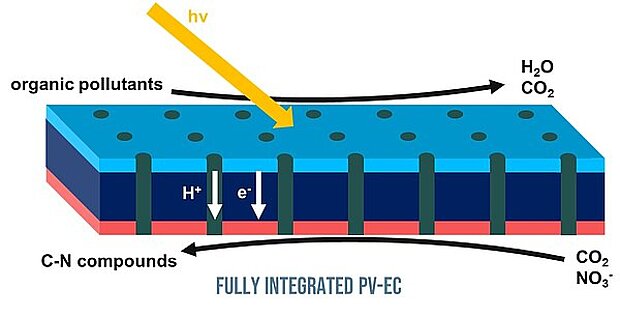
In this part of the project, we are developing a new kind of solar-powered device made from porous silicon. Uniquely, this material will act both as a solar panel (to capture sunlight and generate electricity) and as a membrane (to separate and control chemical reactions).
This dual function is important because it allows:
- Electric charges and protons (small charged particles) to move through the material from one side of the device to the other,
- While still keeping different chemicals separated, so reactions stay efficient and controlled.
We aim to:
- Build a more powerful solar element by stacking multiple silicon layers, enabling higher voltages.
- Improve how electricity flows through the material, increasing overall efficiency.
- Reduce unwanted mixing of reaction products, which can lower performance.
Selective & High-Yield Catalysts for CO2RR (WP3)
WP Leader: Damien Voiry (UM & CNRS)
In this part of the project, we are developing special materials called electrocatalysts that can use electricity (powered by sunlight) to convert carbon dioxide (CO2) into valuable chemicals.
The goal is to efficiently produce useful substances such as formic acid, acetic acid, formaldehyde and acetaldehyde, which are widely used in industry, so this approach could help turn waste CO2 into something valuable.
To achieve this, we will:
- Design advanced catalysts with multiple active sites, meaning they have several “working spots” where reactions can happen at the same time.
- This helps guide the reaction step-by-step, improving both efficiency and selectivity (so we mainly get the desired products, not unwanted ones).
- Overcome current limitations that normally make it hard to control these reactions.
We will also:
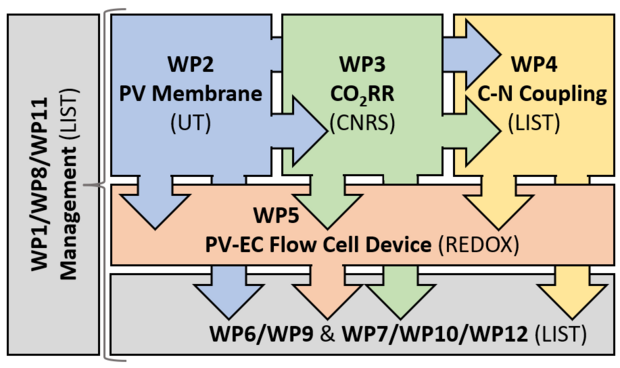
- Integrate these catalysts on the silicon PV membrane developed in WP2, so sunlight can directly drive the CO2 conversion.
- Identify the best reactions and catalyst combinations to produce complex chemicals containing both carbon and nitrogen in WP3.
Selective & High-Yield Electrocatalysts for C-N Coupling (WP4)
WP Leader: Amr A. Nada (LIST)
In this part of the project, we develop special electrocatalysts that can combine carbon (from CO2) and nitrogen (from nitrate or ammonia) to create useful chemicals.
The goal is to efficiently produce important compounds such as:
- Urea (commonly used in fertilizers)
- Formamide and acetamide (used in chemical manufacturing)
- Methylamine and ethylamine (building blocks for pharmaceuticals and other products)
To achieve this, we will:
- Design and create advanced catalysts that can carefully guide reactions to form bonds between carbon and nitrogen atoms.
- Ensure the process is both selective (producing mostly the desired chemicals) and high-yield (producing them efficiently).
- Study and improve how these reactions happen step by step.
We will also:
- Integrate these catalysts on the silicon PV membrane developed in WP2, where sunlight provides the energy needed to drive these chemical transformations.
- Work closely with other parts of the project to identify the best reactions and catalyst designs, which will later be used in a fully integrated system in WP5.
Fully-Integrated PV-EC Flow Cell Device for C-N Coupling (WP5)
WP Leader: Pawel Wojcik (REDOX)
In this final part of the project, we bring everything together to build a fully integrated, small-scale prototype that uses sunlight to convert CO2 and nitrate into valuable chemicals.
The goal is to create a standalone device that combines all key components—solar energy capture, catalysts, and chemical reaction system—into one working unit.
We will:
- Assemble and test the complete system, including all supporting parts needed for operation.
- Measure how well the device performs, looking at how much product it makes, how efficiently it uses energy, how selectively it produces the desired chemicals, and where energy or material losses occur.
We will also:
- Evaluate the overall technology, including: a techno-economic analysis (TEA) to understand costs and economic potential and a life cycle assessment (LCA) to measure environmental impact.
- Compare this new approach to existing industrial methods, aiming to show that it can be more cost-effective and sustainable.
- Simplify the overall system design, reducing complexity and making it easier to scale up in the future.